
Melting Equipment
From small quantities to multi-component alloys. We achieve high-quality alloy production with extensive equipment and proven technology.
We possess a variety of equipment including vacuum melting furnaces, arc melting furnaces, skull melting furnaces, and gas atomizers. Leveraging our experience and knowledge in alloy manufacturing cultivated over many years, we flexibly respond to prototyping and development needs from small quantities, covering binary to ternary, quaternary, quinary, and higher multi-component alloys. We strongly support our customers' material development from research and development to practical application studies.
We also provide contract services for alloy production.
An inquiry form is also available on the download page.

Melting Process
In the melting process, raw metals with a purity of 99.9% to 99.999% are typically used. The melting method is determined based on the melting volume and material properties (melting point/reactivity), and melting is performed under optimal conditions.
Additionally, forging and rolling plastic working are performed as needed.
Vacuum Melting Furnace
Metals and alloys with melting points up to 1700°C are melted in a vacuum. By melting using electromagnetic induction heating, the molten metal is stirred, resulting in an alloy with uniform composition.
We have vacuum melting furnaces capable of melting 1 to 50 kg (iron equivalent), meeting customer needs from small-lot spot items for R&D purposes to mass production line products.
We have earned customer trust by providing products with high quality, low prices, and short lead times.
-
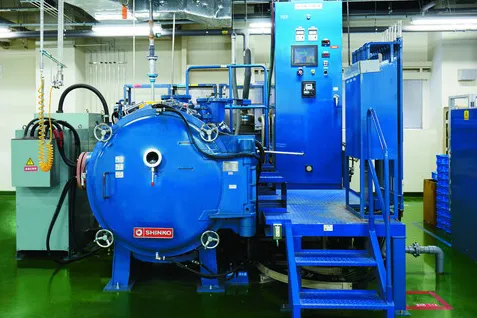
Large Melting Furnace -

Characteristics
- Metals are melted in a vacuum using electromagnetic induction heating.
- Induction heating stirs the molten metal, resulting in a uniform composition.
- Melting in a vacuum removes gas components from the raw materials and prevents new oxidation. It also prevents the contamination of impurities.
- Molten metal is poured into molds to produce ingots and other products.
Main Products
Fe-based alloys, Ni-based alloys, Co-based alloys, Al-based alloys, various materials for sputtering targets, and other special alloys (e.g., Heusler alloys, Ir-Mn alloys)-Mn合金)
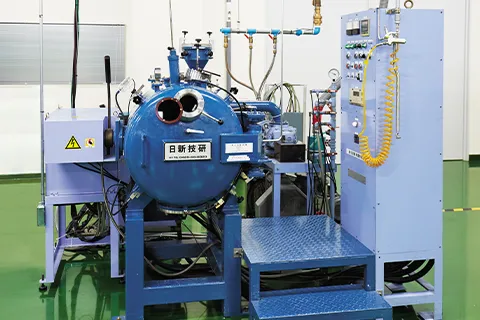
Arc Melting Furnace
In an inert gas atmosphere, arc discharge is generated between a tungsten electrode (cathode) and materials placed on a cooled hearth (anode), and the heat is used for melting.
This enables melting of high-melting-point or reactive metals and alloys that cannot be melted in vacuum melting furnaces.
Melting is possible in sizes ranging from approximately φ50 to φ200.
Characteristics
- Melting of reactive metals and alloys is possible.
- Small items are melted using a single electrode, while larger items are melted using multiple electrodes.
- Homogeneity can be improved by flipping the sample and performing multiple melting cycles.
Main Products
LaSi-based, V-based, Ti-based, etc.
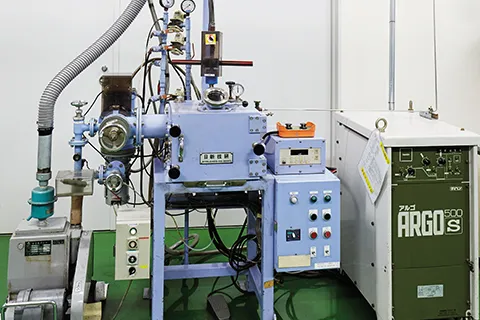
Skull Melting Furnace (CCIM)
By melting in a water-cooled copper crucible, highly reactive metals can be melted without contamination from refractories. Unlike arc melting, vacuum melting is possible depending on the material.
Characteristics
- No reaction with refractories
- Melting capacity of approximately 2.2 kg (iron equivalent)
Main Products
Ti alloys, Zr alloys, etc.
Gas Atomizer
We support not only typical compositions but also customized compositions. Metal melted by high-frequency induction is atomized by gas spraying to obtain spherical powder.
Characteristics
- Compatible with multi-component alloy powders
- Melting capacity up to approximately 10 kg
- Classification by sieving is possible after pulverization
Main Products
Ag alloys, Al alloys, Cu alloys, Bi alloys, etc.
In addition to products, we also provide contract alloy production services using melting technology.
We will respond with the optimal melting method according to your desired alloy size, raw material properties, melting volume, and other requirements.
An inquiry form is also available on the download page.