
Metalorganic Compounds
What's Metal Organic Compounds
"We manufacture organometallic complexes and salts as metal organic compounds.
Salts of metals and alcohols such as Sr(O-i-C₃H₇)₂, Ti(O-i-C₃H₇)₄, and Nb(OC₂H₅)₅ are collectively called alkoxides.
Alkoxides are a group of substances in which the hydroxyl group (-OH) of the corresponding metal hydroxide is replaced with an alkoxyl group (-OCH₃, -OC₂H₅, -OC₃H₇, etc.). These substances are generally soluble in organic solvents and have properties that make them easily hydrolyzed. This property is utilized for the purpose of synthesizing oxides with characteristics different from those synthesized in aqueous phase.
Since hydrolysis in organic solvents can be carried out at low ion concentrations, it easily produces sols, and when sols are left standing, heated, or subjected to vibration, they gelate. Therefore, this method is used for the synthesis of homogeneous complex oxides called the sol-gel method and for the production of spherical oxide powders.
Highly volatile alkoxides are also used in CVD methods and other applications."
Metal Alkoxides
Product Examples
- Ta(OC₂H₅)₅
- Ti(O-i-C₃H₇)₄
- Hf(O-t-C₄H₉)₄
- Al(O-sec-C₄H₉)₃
- Ba(OC₂H₅)₂
- LiOC₂H₅

Lanthagen®
In recent years, lanthanoid alkoxides, including La, have attracted attention as source materials for asymmetric synthesis catalysts. Among these, the catalytic activity of our lanthanoid alkoxides has been highly evaluated by many customers.
We have developed a catalytic activity evaluation method for lanthanoid alkoxides to evaluate the activity of asymmetric synthesis catalysts (patented), and we evaluate each production lot and provide products that pass as Lanthagen®.
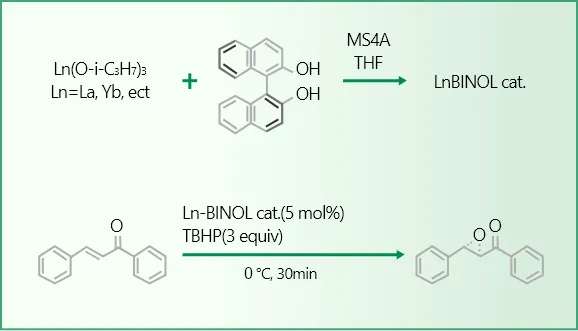
Outline of the catalytic activity evaluation method
The catalytic activity evaluation value is indicated by the reaction rate and asymmetric yield of the asymmetric epoxidation reaction of chalcone using an Ln-BINOL catalyst prepared from lanthanoid alkoxide and BINOL ((S)-2,2'-dihydroxy-1,1'-binaphthyl).
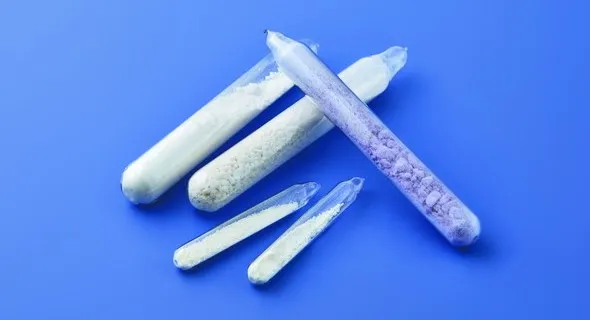
Line-up of lanthanide alkoxides for catalysts
| Product Name | Lanthagen® Tri-isopropoxy Lanthanum | Lanthagen® Tri-isopropoxy Praseodymium | Lanthagen® Tri-isopropoxy Samarium | Lanthagen® Tri-isopropoxy Gadolinium | Lanthagen® Tri-isopropoxy Ytterbium | Lanthagen® Tri-isopropoxy Yttrium | |
|---|---|---|---|---|---|---|---|
| Chemical formulae | La(O-i-C₃H₇)₃ | Pr(O-i-C₃H₇)₃ | Sm(O-i-C₃H₇)₃ | Gd(O-i-C₃H₇)₃ | Yb(O-i-C₃H₇)₃ | Y(O-i-C₃H₇)₃ | |
| Name | Lanthanum tri-isopropoxide | Praseodymium tri-isopropoxide | Samarium tri-isopropoxide | Gadolinium tri-isopropoxide | Ytterbium tri-isopropoxide | Yttrium tri-isopropoxide | |
| CAS No. | 19446-52-7 | 19236-14-7 | 3504-40-3 | 14532-05-09 | 6742-69-4 | 2172-12-5 | |
| Molecular Weight | 316.2 | 318.2 | 327.6 | 334.5 | 350.3 | 266.2 | |
| Properties | White solid | Light green solid | Yellow-orange solid | White solid | White solid | White solid | |
| Solubility (g/L) | THF | 320 | 300 | 470 | 250 | 310 | 240 |
| Toluene | 200 | 220 | 280 | 290 | 270 | 200 | |
| Hexane | 270 | 310 | 470 | 250 | 310 | 240 | |
| IPA | 80 | 50 | 40 | 30 | 180 | 20 | |
| Catalyst performance | yield(%) | ≥55 | ≥63 | ≥54 | ≥82 | ≥41 | ≥84 |
| ee(%ee) | ≥70 | ≥51 | ≥56 | ≥51 | ≥62 | ≥15 | |
We also handle acetates, carboxylates, β-diketone complexes, and more.